Can You Buy Land and Build a House in Austin? Guide
June 25, 2026 · 13 min read
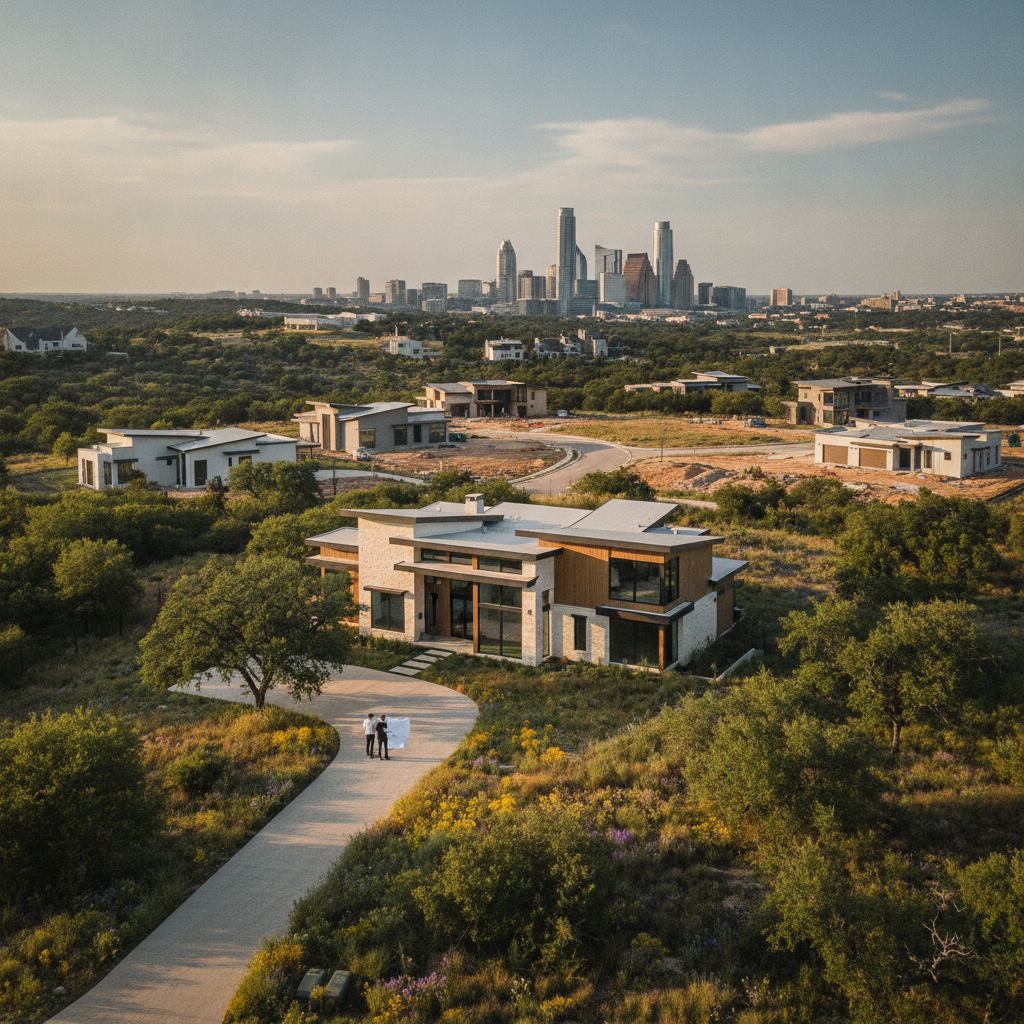
Can you buy land and build a house in Austin? The short answer is yes — and in 2026, it remains one of the most strategic paths to homeownership and investment in Central Texas. But the process is far more nuanced than it was even three years ago, with shifting zoning rules, evolving permitting timelines, and a cooling market that's reshaping land values across Travis, Williamson, Hays, and Bastrop counties.
TL;DR — The Bottom Line
Yes, you can buy land and build a house in Austin in 2026. Expect construction costs of $150–$250 per square foot, lot budgets of 25–40% of your total project cost, and 12–24 months from land purchase to move-in. Success depends on jurisdiction (City of Austin vs. ETJ vs. county), zoning, utilities, and financing structure. Work with an experienced local team like Zell Team to navigate the process.
Whether you're a first-time buyer priced out of resale inventory, an investor eyeing build-to-rent opportunities, or a homeowner seeking a fully custom build, this comprehensive guide breaks down everything you need to know. We'll cover budgeting formulas, jurisdictional rules, financing structures, timelines, and the critical questions to ask before signing a land contract.
Austin Market Snapshot: Why Build Instead of Buy?
So, can you buy land and build a house in Austin and come out ahead financially? In many cases, yes — especially when resale inventory is limited in your target neighborhood or when you want long-term efficiency, customization, and warranty coverage.
Building in Texas typically runs $150–$250 per square foot, with higher ranges in fast-growing metros like Austin. Compare that to Austin's median starter resale home price of roughly $330,000, which requires a household income near $118,000 under typical debt-to-income assumptions. New construction often costs more upfront, but it delivers modern energy efficiency, smart-home wiring, and zero deferred maintenance — features that increasingly drive long-term resale value.
Quick Facts
- Construction Cost (TX): $150–$250 per sq ft
- Ideal Lot Budget: ~33% of total project cost
- Max Lot Budget: 40% of total project cost
- Floor-Area Ratio (FAR) Rule: ~0.4 for Austin lots
- Typical Build Timeline: 10–14 months after permits
- Permitting Timeline (City of Austin): 4–9 months
Land Availability and Pricing Trends
Urban lots inside the City of Austin remain scarce and expensive, especially in established neighborhoods like Zilker, Bouldin Creek, Tarrytown, and Crestview. Meanwhile, the extraterritorial jurisdiction (ETJ) and surrounding counties offer larger parcels at substantially lower per-acre prices. For buyers asking, "can you buy land and build a house in Austin without breaking the bank?" — the answer often lies just outside city limits.
A practical rule of thumb: your lot cost should be roughly 25–40% of the final home value, with 33% or less considered ideal. For a $900,000 total project budget, aim for land at or below $300,000. Stretch beyond 40% and your build budget — and your eventual appraised value — start to suffer. Learn more about current market dynamics on our Austin market updates page.
Strategic Budgeting: Land + Build Numbers That Actually Work
Before you even tour a parcel, you need a clear financial model. Most buyers underestimate soft costs — design fees, surveys, soils tests, utility connections, impact fees, and permitting — which can add 10–20% on top of hard construction costs.
The Austin Lot Budget Formula
- Maximum lot budget = Total project budget × 0.40
- Ideal lot budget = Total project budget × 0.33
Minimum Lot Size for Your Desired Home
Austin builders commonly use a floor-area ratio (FAR) of approximately 0.4 as a conservative planning assumption. To estimate the smallest lot you'll need:
Minimum lot size = Desired home size ÷ 0.4
Example: To build a 2,400 sq ft home, target a lot of at least 6,000 sq ft (2,400 ÷ 0.4). On smaller lots, you'll be limited by setbacks, lot coverage maximums, and impervious cover restrictions — all of which are stricter inside the City of Austin.
For a mid-range custom home of 2,400 sq ft, plan on $700,000–$1,000,000 all-in: roughly $200K–$300K for land, $400K–$600K for construction, plus $40K–$80K for design, permits, utilities, and contingency. High-end custom builds in central Austin can easily exceed $1.5M.
Construction Cost Range
Texas-wide construction costs range from $150–$250 per square foot, with custom or constrained infill sites in Austin running higher. A 2,400 sq ft custom home translates to roughly $360,000–$600,000 in hard build costs alone, before land, design, utilities, and permitting.
Where You Buy Matters: City vs. ETJ vs. County
One of the most important questions to answer before purchasing a parcel is: which jurisdiction controls it? The rules, costs, and timelines change dramatically depending on whether the land sits inside the City of Austin, within its extraterritorial jurisdiction, or in unincorporated county territory.
Inside the City of Austin
- Subject to City of Austin zoning (SF-1, SF-2, SF-3, etc.), building codes, impact fees, and full permitting review.
- More walkable, higher resale ceiling, but smaller lots and tighter rules.
- Restrictive setbacks, height limits, lot coverage maximums, impervious cover caps, and robust tree-protection ordinances.
- Longer permitting timelines — often 4–9 months for new single-family construction.
ETJ (Extraterritorial Jurisdiction)
- Areas just outside city limits, still subject to certain Austin and county overlays.
- Often a sweet spot for small developers, custom builders, and investors who want fewer constraints than in-city but more structure than raw county land.
- Recent state-level legislation has shifted ETJ release rules — always verify current jurisdiction with a title company and the city.
County-Only Parcels (Travis, Williamson, Hays, Bastrop)
- Governed primarily by county rules and Texas state code.
- Looser zoning, more flexibility on home size, outbuildings, barndominiums, and small-ranch uses.
- You're responsible for water (often a private well), septic system design and permitting, and bringing electric and internet to the site.
Financing Options: How to Pay for Land and Construction
Financing is where many would-be land buyers stumble. Traditional 30-year mortgages don't apply to raw land or partially-built homes, so you'll need specialized loan products.
Land Loans
If you're buying the lot first and building later, a land loan covers the parcel purchase. Expect:
- Down payments of 20–35% (raw land requires more than improved lots).
- Shorter terms (often 5–15 years) and higher interest rates than conventional mortgages.
- Stricter underwriting — lenders want to see your build plan and timeline.
Construction-to-Permanent Loans
The most common structure for buyers who want to roll land + build into one financing event:
- Single closing covers land acquisition (if not already owned) and construction.
- Funds disburse to the builder in scheduled "draws" tied to construction milestones.
- Converts automatically to a standard 15- or 30-year mortgage when construction completes.
- Typically requires 10–25% down on the total project cost.
Cash + Construction Loan
Investors and high-net-worth buyers often pay cash for the lot and finance only the build. This simplifies underwriting and can speed up the timeline. Talk to our team via the Zell Team contact page for lender introductions tailored to your strategy.
Yes. A construction-to-permanent loan (also called a single-close construction loan) bundles land acquisition, construction draws, and the final mortgage into one transaction with one set of closing costs. This is the most efficient path for most owner-occupants.
Step-by-Step: How to Buy Land and Build a House in Austin
Here's the proven sequence we walk clients through at Zell Team:
- Define your total project budget. Include land, construction, design, permits, utilities, landscaping, and a 10–15% contingency.
- Get pre-qualified for financing. Talk to lenders who specialize in land and construction loans — not just conventional mortgages.
- Identify target areas and jurisdictions. Decide whether you want in-city walkability, ETJ flexibility, or county acreage.
- Tour parcels with an experienced agent. Evaluate lot orientation, slope, trees, floodplain, utility access, and resale potential.
- Conduct due diligence under option period. Order a survey, soils test, title search, and verify zoning, deed restrictions, and HOA rules.
- Close on the land (or move to construction-to-perm closing if combining).
- Hire your architect and builder. Finalize plans, get bids, and lock construction pricing.
- Submit for permits. Plan for 4–9 months in the City of Austin; faster in counties.
- Build the home. Typical timeline: 10–14 months from permit issuance to certificate of occupancy.
- Final walkthrough and conversion to permanent mortgage.
From start to finish, expect 18–30 months. Yes, it's a marathon — but the result is a home built exactly to your specifications.
Common Pitfalls (and How to Avoid Them)
When clients ask, "can you buy land and build a house in Austin without major surprises?" the honest answer is: only with disciplined due diligence. Here are the most expensive mistakes we see:
Buying Land Without Verifying Utilities
That gorgeous five-acre parcel in eastern Travis County might be miles from a water main. Extending utilities can cost $20,000–$100,000+. Always confirm what's at the property line and what it costs to connect.
Ignoring Floodplain and Drainage
Austin's flash-flood history is no joke. A parcel partially in the 100-year floodplain can drastically limit your buildable area, raise insurance costs, and complicate financing. Pull a FEMA map before you make an offer.
Underestimating Soft Costs and Site Work
Tree protection, retaining walls, custom foundations on sloped lots, long driveways, septic engineering — all of these can add tens of thousands beyond your base contract. Build a 10–15% contingency into every project.
Choosing the Wrong Builder
Not every builder excels at custom Austin infill, hill-country slopes, or rural construction. Match the builder to the site. Our team maintains relationships with vetted custom builders across Central Texas — see our resources and builder network page.
"The biggest determinant of whether a land-and-build project succeeds isn't the lot or the floorplan — it's the team you assemble before you ever break ground."
For Investors and Developers: Build-to-Sell and Build-to-Rent
Beyond owner-occupants, can you buy land and build a house in Austin profitably as an investor? Absolutely — but the math has to work at scale.
Build-to-Sell (Spec Homes)
Margins on Austin spec homes have compressed since 2022, but well-located infill builds in established neighborhoods still pencil out at 12–20% gross margins when land is acquired correctly. Watch for:
- Lot premium overpayment (don't break the 33% rule).
- Specification creep that pushes you above neighborhood comps.
- Permit delays that extend your carrying costs.
Build-to-Rent (BTR)
Single-family BTR has exploded in Austin's outer suburbs. Investors target larger ETJ or county parcels for small clusters (4–20 homes) optimized for rental yield rather than retail buyer appeal. Floorplans skew toward 3-bed/2-bath efficiency, and finishes are durable rather than luxury.
Comparison Table: City vs. ETJ vs. County Land
| Factor | City of Austin | ETJ | County (Travis/Williamson/Hays/Bastrop) |
|---|---|---|---|
| Typical Lot Price | High ($250K–$1M+) | Moderate ($100K–$400K) | Lower per acre ($50K–$300K) |
| Zoning Restrictions | Strict (SF-1 to SF-3) | Moderate | Minimal |
| Permitting Timeline | 4–9 months | 2–5 months | 1–3 months |
| Utilities | Usually available | Mixed | Often well + septic |
| Resale Demand | Strongest | Strong | Variable |
| Best For | Custom owner-occupants | Builders, mid-budget custom | Acreage, barndominiums, BTR |
Frequently Asked Questions
Can you buy land and build a house in Austin as a first-time buyer?
Yes, but it's more complex than buying existing inventory. First-time buyers should work with a lender who offers construction-to-permanent loans with low down payments (some programs allow 10–15% down), and partner with a real estate team experienced in land acquisition. Expect the full process to take 18–30 months.
How long does it take to build a custom home in Austin?
Plan on 4–9 months for permitting (longer inside city limits) plus 10–14 months of construction. From land closing to move-in, 18–24 months is typical. Counties with looser permitting can shave 3–6 months off the front end.
Is it cheaper to buy land and build or buy an existing home in Austin?
In 2026, buying existing inventory is usually cheaper per square foot — but you get less control, older systems, and potential deferred maintenance. Building offers customization, energy efficiency, and warranty coverage, but typically costs 10–25% more all-in. The right answer depends on your timeline, neighborhood preference, and long-term plans.
What's the minimum lot size to build a house in Austin?
Inside the City of Austin, minimum lot sizes vary by zoning category — SF-3 lots can be as small as 5,750 sq ft. In the ETJ and counties, minimums are governed by septic and well requirements, often pushing toward 1 acre or more if you're not on public utilities.
Do I need a real estate agent to buy land in Austin?
You don't legally need one, but it's strongly recommended. Land transactions involve unique due diligence — surveys, soils, easements, floodplain, jurisdiction, utility access, deed restrictions — that most buyers aren't equipped to evaluate alone. An experienced agent like Zell Team protects you from costly surprises.
Conclusion: Your Next Step
So, can you buy land and build a house in Austin in 2026? Yes — and for many buyers, investors, and developers, it's the smartest path to a home that perfectly fits your life, lifestyle, or investment thesis. The opportunity is real, but so are the complexities: jurisdiction, zoning, financing, builder selection, and timeline management all demand expert guidance.
At Zell Team, we've spent over five decades collectively helping Austin clients navigate the land-and-build process — from urban infill in central neighborhoods to acreage in the surrounding hill country. Whether you're searching for your forever home, building a spec project, or assembling a build-to-rent portfolio, we'll help you find the right parcel, structure the right financing, connect with the right builder, and avoid the costly mistakes that derail less-prepared buyers.
Ready to explore your options? Visit zellteam.com/contact to schedule a no-obligation strategy session. Let's turn your vision into a home — and a smart investment — built right here in Austin.