Cost of Living in Austin vs Dallas: 2026 Relocation Guide
June 18, 2026 · 13 min read

Choosing between Texas's two most talked-about metros is rarely simple. The cost of living in Austin vs Dallas involves more than home prices — it's a layered comparison of housing, utilities, transportation, taxes, and lifestyle that shifts depending on your income, family size, and priorities. Whether you're a homeowner thinking about cashing out Austin equity, a buyer weighing your first Texas purchase, or an investor scouting yields, understanding the real numbers behind the cost of living in Austin vs Dallas will sharpen every decision you make in 2026.
TL;DR — The Bottom Line
Austin's median home price (~$525,000) is roughly 25–30% higher than Dallas's (~$415,000), making housing the single biggest cost driver. However, several 2026 calculators show Dallas's day-to-day expenses (utilities, groceries, services) running 3–4% higher than Austin's. Net effect: Dallas usually wins on housing affordability and square footage, while Austin justifies its premium for tech salaries, lifestyle, and long-term appreciation. The right choice depends on whether your budget is housing-sensitive or income-flexible.
Quick Facts
- Austin Overall Cost Index (2026): ~115 (national avg = 100)
- Dallas Overall Cost Index (2026): ~102
- Austin Median Home Price: ~$525,000
- Dallas Median Home Price: ~$415,000
- Housing Cost Difference: Austin ~30% higher than Dallas
- State Income Tax: 0% in both cities (Texas advantage)
- Property Tax Rate (effective): Austin ~1.8%, Dallas ~2.0%
Big-Picture Cost of Living in Austin vs Dallas
At the macro level, the cost of living in Austin vs Dallas tells a clear but nuanced story. A 2026 Texas metro comparison places Austin's overall cost-of-living index at roughly 115 versus Dallas at 102, with the national average set at 100. That implies Austin is about 13% more expensive overall — almost entirely driven by housing. Drill into the housing sub-index and the gap widens: Austin scores 135 while Dallas sits at 105.
But not every calculator agrees. Redfin's 2026 relocation calculator shows Dallas's overall cost of living running about 3–4% higher than Austin's, even while housing remains 8% cheaper in Dallas. Salary.com mirrors that finding, suggesting Austin requires roughly 3.8% more total budget than Dallas for an equivalent lifestyle. Crowdsourced Numbeo data — which leans heavily on user-reported rents in cooled urban cores — puts Austin about 2.8% cheaper than Dallas when rent is included.
Why the disagreement? It comes down to weighting. Calculators that heavily emphasize housing show Austin as pricier. Those that balance utilities, groceries, lifestyle, and services more evenly often flip the result. The cost of living in Austin vs Dallas, in other words, depends on which costs dominate your personal budget.
"All sources agree on one core point: housing costs in Austin are meaningfully higher than in Dallas. The disagreement is only about how much the rest of the budget offsets that gap."
Housing: Where the Cost of Living in Austin vs Dallas Diverges Most
If you remember one thing about the cost of living in Austin vs Dallas, make it this: housing is the variable that moves the needle. Every reputable 2026 data source confirms Austin remains the more expensive Texas housing market, even after correcting from its 2022 peak.
Purchase Prices in 2026
- Austin metro median home price: ~$525,000, up roughly 1.5% YoY but still about 17% below the 2022 peak near $550,000.
- Dallas metro median home price: ~$415,000, up roughly 3.2% YoY.
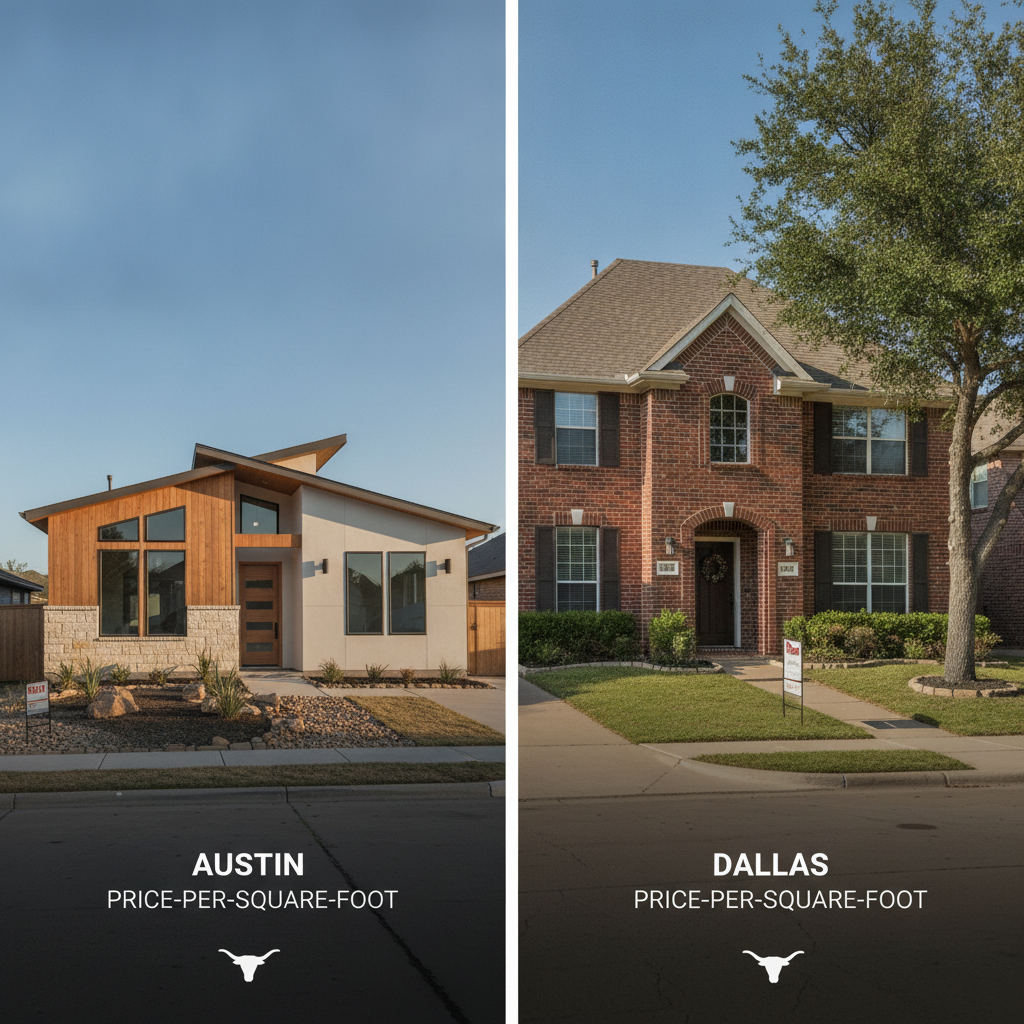
- Per-square-foot: Austin averages $290–$320/sqft; Dallas averages $210–$240/sqft.
A buyer purchasing a 2,200 sqft home in Austin will typically spend $110,000–$180,000 more than for the same home in Dallas. For Austin homeowners considering a move-up, downsize, or relocation, this gap is exactly the kind of equity arbitrage our team at Zell Team helps clients quantify before listing.
Rental Markets
Renters see a similar but less dramatic gap. Average 2026 rents:
- Austin 1-bedroom: $1,650–$1,850
- Dallas 1-bedroom: $1,350–$1,500
- Austin 2-bedroom: $2,150–$2,450
- Dallas 2-bedroom: $1,750–$1,950
Slightly, yes. Austin's median home price has fallen about 17% from its 2022 peak while Dallas has continued modest appreciation. The gap is narrower than it was three years ago, but Austin housing still costs 25–30% more on a typical comparable home.
Property Taxes and Insurance: The Hidden Cost of Living in Austin vs Dallas
Texas has no state income tax, which is a real win in both metros. But that tax-free salary is partially offset by some of the highest property taxes in the country. When comparing the cost of living in Austin vs Dallas, property tax math often surprises new buyers.
Effective Property Tax Rates (2026)
- Austin (Travis County): ~1.8% effective rate
- Dallas (Dallas County): ~2.0% effective rate
On paper, Dallas has the higher rate. But because Austin homes carry higher assessed values, the annual dollar amount usually lands higher in Austin. Example:
- Austin $525,000 home × 1.8% = $9,450/year
- Dallas $415,000 home × 2.0% = $8,300/year
Homeowners insurance also runs slightly higher in the Dallas–Fort Worth area due to hail and severe weather exposure, averaging $2,800–$3,400/year versus Austin's $2,300–$2,900/year. For investors modeling cap rates, these line items meaningfully affect net yield — a topic we cover in depth on the Zell Team blog.
Utilities, Groceries, and Daily Expenses
Outside housing, the cost of living in Austin vs Dallas tightens considerably — and Dallas sometimes pulls ahead in expense.
Utilities
Texas summers are brutal, and electricity bills reflect that. 2026 averages:
- Austin monthly utilities (2-bed apt): $180–$230
- Dallas monthly utilities (2-bed apt): $200–$260
Dallas tends to run hotter for longer, which lifts cooling costs. Austin's municipally owned Austin Energy also offers more rate predictability than Dallas's deregulated retail electricity market, where shopping for plans is essentially mandatory.
Groceries
Grocery indices favor Dallas slightly, but the gap is small — typically 2–4%. A household spending $1,000/month on groceries in Dallas would spend roughly $1,030–$1,040 in Austin. H-E-B's pricing dominance in Central Texas keeps Austin competitive despite the broader cost premium.
Transportation
Here Dallas's larger geographic footprint and heavier traffic show up:
- Average commute time: Austin ~26 min; Dallas ~28 min
- Gas prices: Comparable, both near $2.95–$3.15/gallon
- Auto insurance: Dallas averages 8–12% higher due to claim frequency
- Public transit: Dallas DART is more extensive; Austin CapMetro is improving but limited
Salaries, Job Markets, and Net Take-Home Comparison
A fair view of the cost of living in Austin vs Dallas has to weigh income alongside expenses. Both cities have strong, diversified economies, but their salary profiles differ.
- Austin median household income (2026): ~$92,000
- Dallas median household income (2026): ~$78,000
- Austin average tech salary: ~$135,000
- Dallas average tech salary: ~$118,000
Austin's tech concentration — Apple, Tesla, Oracle, Meta, and a thriving startup base — pushes salaries higher, which is why high-income relocators often find Austin's premium digestible. Dallas's economy is broader (finance, healthcare, logistics, telecom, energy), offering more stability across industries but slightly lower top-end wages.
For households under ~$150,000 income, Dallas typically leaves more money in your pocket because housing eats less of the budget. Above ~$200,000 — particularly for tech workers — Austin's salary premium often outpaces the housing gap, making Austin's higher cost of living self-funding.
Lifestyle, Schools, and Intangibles
Numbers tell only part of the story. The cost of living in Austin vs Dallas also involves lifestyle trade-offs that don't show up in any index.
Schools
Both metros offer top-tier suburban districts. Austin-area standouts include Eanes ISD (Westlake), Lake Travis ISD, and Leander ISD. Dallas suburbs counter with Highland Park ISD, Plano ISD, Frisco ISD, and Southlake Carroll. School quality is roughly comparable at the top end; the cost difference is often in the price of homes zoned into those districts. A Westlake home in Eanes ISD will typically cost 20–40% more than an equivalent home in Plano ISD.
Outdoor Lifestyle
Austin's hill country, greenbelts, Lady Bird Lake, and Barton Springs give it a definitive outdoor identity. Dallas is flatter, hotter, and more urban — though White Rock Lake, Klyde Warren Park, and the Trinity River corridor are improving. If outdoor recreation is part of your value calculus, Austin's premium becomes easier to justify.
Culture and Dining
Dallas offers a deeper, more cosmopolitan dining and arts scene with major museums, an established symphony, and championship-level pro sports across four leagues. Austin counters with live music, festivals (SXSW, ACL), and a more casual, creative culture. Both cities are world-class — they just appeal to different temperaments.
Investor and Developer Perspective
For investors, the cost of living in Austin vs Dallas translates into very different deal economics.
- Austin gross rental yields: 4.5–5.5% on single-family
- Dallas gross rental yields: 5.5–7.0% on single-family
- Austin appreciation (10-yr CAGR): ~8.2%
- Dallas appreciation (10-yr CAGR): ~6.8%
Dallas wins on cash flow; Austin wins on long-term appreciation and tech-driven demand. Developers face higher land basis and tougher entitlement in Austin, but exit pricing rewards the patience. We work with investors regularly to model both scenarios — start with our consultation page if you want a side-by-side proforma for your target neighborhoods.
How to Decide: A Step-by-Step Framework
Use this five-step framework to clarify the cost of living in Austin vs Dallas for your specific situation:
- Calculate your housing-to-income ratio in both cities. Aim to keep total housing cost (mortgage + tax + insurance) below 30% of gross income.
- Run a net take-home comparison. Layer salary differential, property tax, insurance, and utilities into a 12-month budget projection.
- Weight your lifestyle priorities. Score outdoor access, dining, schools, and commute on a 1–10 scale for each city.
- Model your 5-year equity scenario. Project appreciation, principal paydown, and selling costs to compare net worth outcomes.
- Stress-test with a job-loss scenario. Which city's housing payment could you sustain on a single income or 6 months of reserves?
Frequently Asked Questions
Is Austin or Dallas cheaper to live in overall in 2026?
It depends on the calculator and your spending pattern. Most cost-of-living indices put Austin's overall index at ~115 versus Dallas at ~102, making Austin roughly 13% more expensive — primarily because of housing. However, Redfin and Salary.com's 2026 tools show Dallas's day-to-day expenses (utilities, groceries, services) running 3–4% higher than Austin's. The cost of living in Austin vs Dallas is housing-driven: if you're buying a home, Dallas wins; if you're a high-earning renter, the gap nearly closes.
How much more expensive are homes in Austin compared to Dallas?
In 2026, Austin's median home price (~$525,000) is roughly 25–30% higher than Dallas's (~$415,000). On a price-per-square-foot basis, Austin averages $290–$320/sqft versus Dallas's $210–$240/sqft. A 2,200 sqft home typically costs $110,000–$180,000 more in Austin than in Dallas.
Are property taxes higher in Austin or Dallas?
Dallas County's effective property tax rate (~2.0%) is slightly higher than Travis County's (~1.8%). But because Austin homes carry higher assessed values, the actual annual tax bill is typically larger in Austin — about $9,450/year on a median home versus $8,300/year in Dallas.
Do salaries in Austin offset the higher cost of living vs Dallas?
For tech workers and high earners, often yes. Austin's median household income (~$92,000) and average tech salary (~$135,000) exceed Dallas equivalents by 15–18%. For households earning under $150,000 in non-tech fields, Dallas typically delivers better net take-home after housing and taxes.
Which city is better for real estate investors — Austin or Dallas?
Dallas offers stronger cash flow with gross rental yields of 5.5–7.0% on single-family properties, versus Austin's 4.5–5.5%. Austin delivers stronger long-term appreciation (10-year CAGR ~8.2% vs Dallas ~6.8%). Cash-flow investors lean Dallas; appreciation-focused investors lean Austin.
Final Take and Next Steps
The cost of living in Austin vs Dallas is ultimately a question of what you optimize for. Optimize for square footage and monthly housing affordability — Dallas wins decisively. Optimize for tech salaries, outdoor lifestyle, and long-term appreciation — Austin justifies its premium. Optimize for cash flow on rentals — Dallas. Optimize for equity growth on a primary residence — Austin still leads despite its recent correction.
If you're an Austin homeowner weighing a Dallas move (or a Dallas resident eyeing Austin), the decision deserves more than a calculator. It deserves a customized financial model, neighborhood-by-neighborhood comparison, and a clear-eyed view of your 5–10 year goals. That's exactly what the Zell Team does for relocating families, investors, and developers every week.
Ready to run the numbers on your specific scenario? Connect with the Zell Team for a personalized cost-of-living and equity analysis tailored to your move. Our combined five-plus decades of Austin real estate experience — and deep network across Texas markets — means you get strategy, not guesswork. Schedule your free consultation today.